
CDCR Releases from Shasta Cases
The California Department of Corrections and Rehabilitation page is for state-prison custody. A Shasta County conviction may begin with local arrest, jail booking, court hearings, and transport from Shasta County Jail, but later release from prison belongs to CDCR. The county jail cannot be expected to keep a live public record of a later state-prison discharge, parole date, PRCS transfer, or Board of Parole Hearings result.
For state-prison cases, start with CDCR CIRIS, the California Incarcerated Records & Information Search. The Sheriff's jail page itself links to a CDCR inmate locator for state prisons, which confirms the split between local jail custody and state prison custody. If a person is not found in CIRIS, that may mean the person never entered CDCR, is under a different name or number, is in another custody system, or needs assistance through CDCR's Identification Unit.
| Question | CDCR Path |
|---|---|
| Still in state prison? | CIRIS current location and custody status. |
| Released or discharged? | CIRIS fields, CDCR records, and parole or PRCS routing. |
| Parole hearing case? | Board of Parole Hearings eligibility, schedules, and results. |
| Supervised in Shasta? | DAPO Redding parole unit or Shasta County Probation for PRCS. |
Use CIRIS for Shasta Releases
CIRIS is the correct first public search for a person in or recently connected to CDCR custody. Searchers should use the legal name, CDCR number if known, and court details such as commitment county or case history to separate similar names. Shasta County should appear as a commitment county only when the state record displays that connection; do not assume every Shasta jail booking becomes a CDCR case.
- Open CIRIS and search by name or CDCR number when available.
- Compare identifiers such as age, commitment county, admission date, and current or last location.
- Look for release, parole, discharge, or eligibility information shown by the public record.
- Check BPH parole eligibility when the case involves parole-date terms such as EPRD, MEPD, NPED, YPED, or EPED.
- Use CDCR contact channels or the Identification Unit if CIRIS cannot be viewed or the record needs agency help.
The official BPH parole-eligibility source says the controlling parole eligible date is publicly available through CDCR's incarcerated-records search engine for incarcerated persons. That date may be a release date, parole consideration date, or eligibility date depending on the sentence.
Shasta CDCR Search Source
The state-prison search starts with CDCR CIRIS, not the Shasta County current-custody lookup.
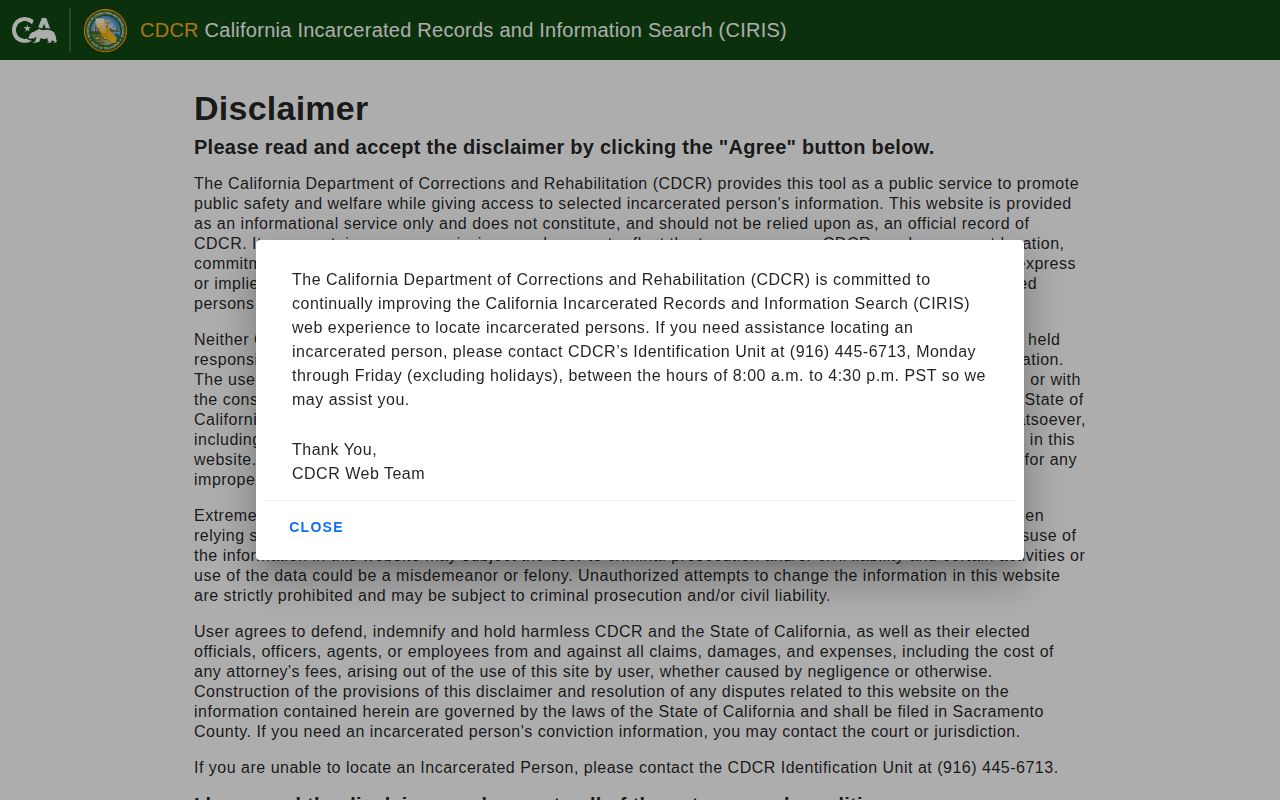
Use the result as a public search lead. For certified records, sentence computation, or a complete discharge packet, contact CDCR or the records office rather than relying on a screenshot.
CDCR Release Date Labels
California release-date language is specific. BPH identifies EPRD as the Earliest Possible Release Date for determinate sentences after applicable earned-time adjustments. MEPD is the Minimum Eligible Parole Date for life-with-possibility cases. NPED, YPED, and EPED refer to nonviolent, youth, and elderly parole eligibility paths. The controlling parole eligible date is the earliest applicable opportunity for release or parole consideration.
| Label | Meaning |
|---|---|
| EPRD | Earliest possible release date for many determinate sentences after applicable earned-time adjustments. |
| MEPD | Minimum eligible parole date for indeterminate life-with-possibility cases. |
| NPED | Nonviolent parole eligible date under the qualifying rules described by BPH. |
| YPED / EPED | Youth or elderly parole eligibility dates when those categories apply. |
For deeper date computation, use Release Date Lookup. Release dates can change because of earned time, resentencing, detainers, court paperwork, parole or PRCS setup, legally required notices, or corrected records.
Shasta CDCR Parole PRCS
CDCR release does not always mean the same kind of supervision. CDCR Victim Services explains that a person who has completed a sentence is released either to state supervised parole or county-level supervision known as PRCS, with the type determined by Penal Code. More serious and violent categories and high-risk sex offender categories tend to state parole. Other eligible categories may go to county supervision.
For Shasta County, state parole may route to the CDCR DAPO Redding Parole Unit at 391 Hemsted Drive, Redding, CA 96002, phone (530) 226-3432. PRCS routes to Shasta County Probation because CDCR says a person released to PRCS is discharged from CDCR jurisdiction and supervised by the county. Use the court record and CDCR record to decide which path applies.
CDCR Redding Parole Unit
391 Hemsted Drive
Redding, CA 96002
Phone: (530) 226-3432
CDCR Records and Contacts
CDCR public search is not a certified record packet. CDCR's contact page identifies the Identification Unit for CIRIS assistance at (916) 445-6713, Monday through Friday, excluding holidays, 8:00 a.m. to 4:30 p.m. Pacific Time. CDCR's main number is 916-324-7308. BPH can be relevant for parole-suitability and eligibility records, with a public mailing address and correspondence contact listed in the research.
If the Shasta case is still local, return to the Shasta Superior Court case and Shasta County Jail release record. If the person was transferred to CDCR, the county record should show the transfer or state-prison commitment, while the state record answers the later release or supervision question.
Note: CIRIS is for CDCR custody and state-prison release; it is not a Shasta County Jail recent-release list.
Redding Parole Local Context
CDCR's rural Redding parole article gives local scale. It says the Redding office serves Shasta, Trinity, Siskiyou, and Modoc counties and described roughly 470 active parole and parolee-at-large people as of the March 25, 2024 article. That regional service area matters because a Shasta release to state parole may involve rural travel, a regional field unit, and state parole conditions rather than a county jail desk.
This local context should not be confused with a public parole roster. Use CIRIS, BPH records when applicable, DAPO contacts, and court records to verify a real case. For county-level supervision, use Shasta County Probation and the Community Corrections Center instead.
CDCR Case Records Processing
CDCR's release process can include more than a date in CIRIS. The CDCR resentencing and release source explains that Case Records professionals process court abstracts and minute orders, check other cases, follow up on detainers, assign parole or PRCS offices, draft parole conditions, arrange required notices, and ensure release funds. That source helps explain why a state-prison release date can change after a court order or after agency review.
For a Shasta County conviction, this means the local court case and the state record should be read together. The Shasta court may show the sentence, abstract, resentencing order, or later correction. CDCR records show how that court action was processed inside the state system. If documents were sent to the wrong office or a detainer has to be resolved, release timing can change even when the public user sees a date field.
BPH Shasta Release Hearings
Some state-prison cases require a Board of Parole Hearings path rather than a simple determinate release. BPH's hearing schedule page identifies hearing dates, times, locations, and whether a hearing will be in person or by video conference. The research notes that schedules are updated weekly on Thursday morning. BPH's parole-suitability overview says the hearing decides whether a person should be released from prison for categories such as life-with-possibility, youth, elderly, or other eligible parole cases.
A parole hearing date is not the same as release. It is a decision point. For Shasta users, BPH records matter only when the Shasta conviction resulted in a CDCR sentence that falls under BPH review. If the person was released from Shasta County Jail on bail, time served, or probation, BPH is not the correct release-confirmation source.
CDCR Is Not County Jail
Use CDCR only after the Shasta case moved into the state-prison system. A county jail detainee released on bail, own recognizance, time served, or a local court order may never appear in CIRIS. A state prisoner may have little current Shasta jail footprint after transfer. The bridge between those systems is the Shasta Superior Court case and the county jail transfer or release field.
When records conflict, follow the custody chain in order: jail booking, court sentence or order, transfer to CDCR, CIRIS/BPH/DAPO records, then PRCS or parole supervision. That sequence keeps a released Shasta County Jail detainee from being mistaken for a CDCR release and keeps a state-prison release from being searched only in county records.
For a person released to PRCS, Shasta County Probation becomes important after the CDCR discharge point. For a person released to state parole, the Redding DAPO unit is the local field contact. Those two outcomes can look similar to a family member trying to locate someone after prison, but the supervising agency is different.