
Shasta County Parole or Probation
Post-release supervision in Shasta County is split between local and state systems. The Shasta County Probation Adult Division states that it supervises convicted felons granted probation, people placed on Post Release Community Supervision after release from state prison, and people sentenced to mandatory supervision. State parole is different. It is handled by the CDCR Division of Adult Parole Operations, often through the Redding Parole Unit for Shasta-area cases.
A released person may pass through more than one record system. A local jail release can be followed by probation, no supervision, a transfer, or a court date. A CDCR release can lead to state parole or PRCS, depending on the sentence and statutory category. The court sentence and CDCR release materials are stronger than a roster result because the jail roster is built around current custody.
| Supervision path | Who handles it | How to verify it |
|---|---|---|
| Formal probation | Shasta County Probation Adult Division | Check Shasta Superior Court sentencing records, then contact probation records through official channels. |
| Mandatory supervision | Shasta County Probation | Review the local sentence and any court order that places part of the term under supervision. |
| PRCS | County supervision after eligible CDCR release | Use CIRIS, CDCR PRCS material, court records, and Shasta County Probation. |
| State parole | CDCR Division of Adult Parole Operations | Use CIRIS, BPH records where applicable, and the Redding Parole Unit. |
- Parole
- State supervision after a CDCR prison release for categories assigned to DAPO.
- Probation
- A court-ordered local supervision term instead of, or after, custody.
- PRCS
- County supervision for eligible people released from CDCR and discharged from CDCR jurisdiction.
- Mandatory supervision
- A split local sentence where part of the term is supervised in the community.
Verify Shasta County Release Supervision
The cleanest supervision check begins with the system that created the release. For a Shasta County Jail case, use the released-inmate search path, the court case, and probation records. For a state-prison case, use CDCR CIRIS and the parole or PRCS branch. If VINE sent a custody-change notice, treat that as a timely alert, then confirm the legal result through court or agency records.
Shasta County's local release trail is often layered. The jail may show that county custody ended, while the court shows probation or mandatory supervision, and CDCR may show whether a state-prison release went to parole or PRCS. A useful supervision check does not try to force those sources into one answer. It asks which agency has current authority today.
- Identify whether the person left the Shasta County Jail, a CDCR prison, federal custody, or a program such as alternative custody.
- Search CIRIS when the case may involve a state-prison term, CDCR number, release date, parole date, or parole-eligibility field.
- Review Shasta Superior Court case records for sentence, probation, mandatory supervision, dismissal, or warrant information.
- Use Shasta County Probation when the record points to probation, PRCS, or mandatory supervision.
- Use CDCR DAPO when the record points to state parole, a parole office, or a parolee-at-large issue.
- For parole-suitability cases, check BPH hearing schedules and results rather than the county jail roster.
Note: A person missing from the Shasta jail lookup may be released, transferred, under a different name, or outside the current feed.
Shasta County Supervising Offices
Shasta County supervision has two local anchors. The county Adult Division is the local probation and PRCS source. CDCR's Redding unit is the regional state parole source. The exact office depends on the release type, so the court case or CDCR record should be checked before assuming the person reports to one office.
The Shasta County Probation Adult Division is the official source for the county side of supervision.
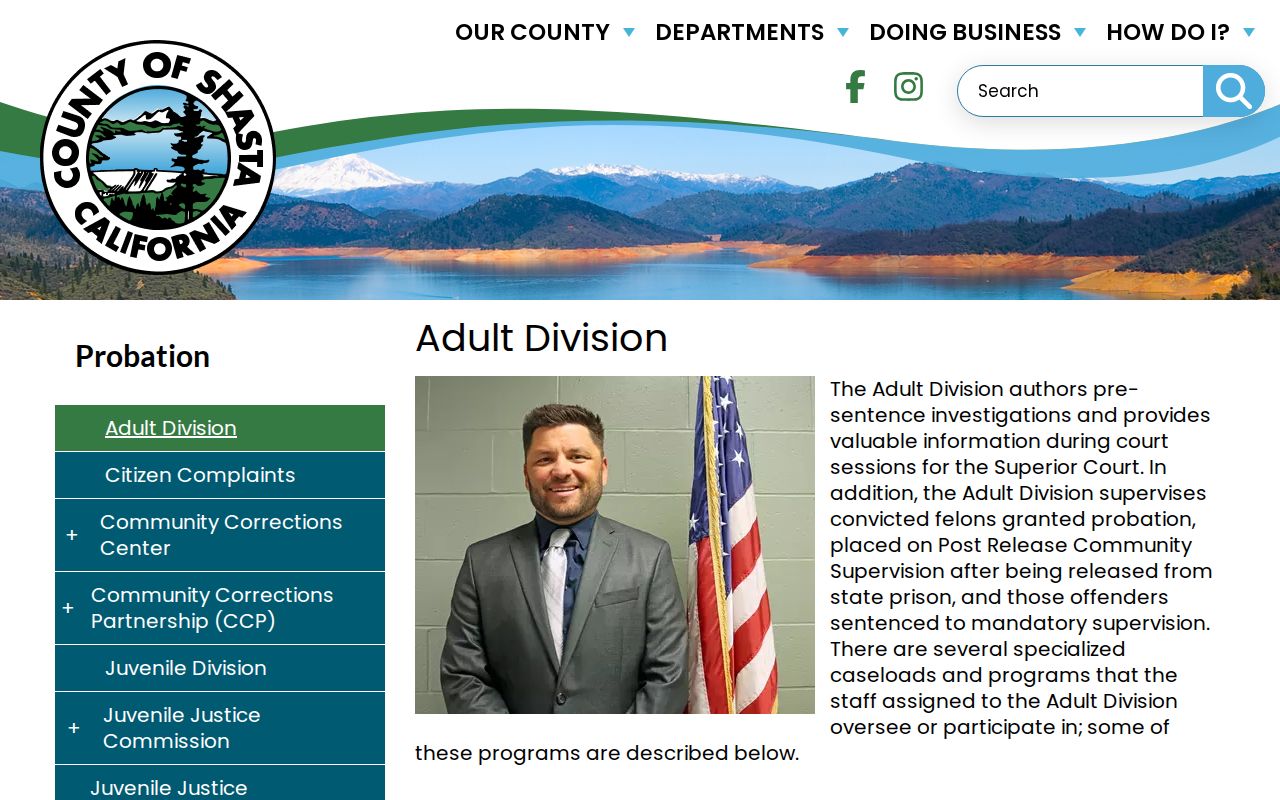
The Adult Division page is the best public starting point when a local court record points to probation, PRCS, or mandatory supervision after release.
Shasta County Probation Adult Division
Adult Division
Supervises formal probation, PRCS, and mandatory supervision for Shasta County matters.
CDCR DAPO Redding Parole Unit
391 Hemsted Drive
Redding, CA 96002
(530) 226-3432
Listed in CDCR's Northern Region directory for state parole field supervision.
The Redding parole office serves a rural region rather than one city desk. CDCR's local article describes the unit as serving Shasta, Trinity, Siskiyou, and Modoc counties with about 470 active parole and parolee-at-large people at the time of that CDCR article. That regional footprint matters when a released state prisoner has a Shasta connection but supervision records point to a broader northern California field unit.
The CDCR Northern Region directory lists the Redding parole unit as the local state parole contact.
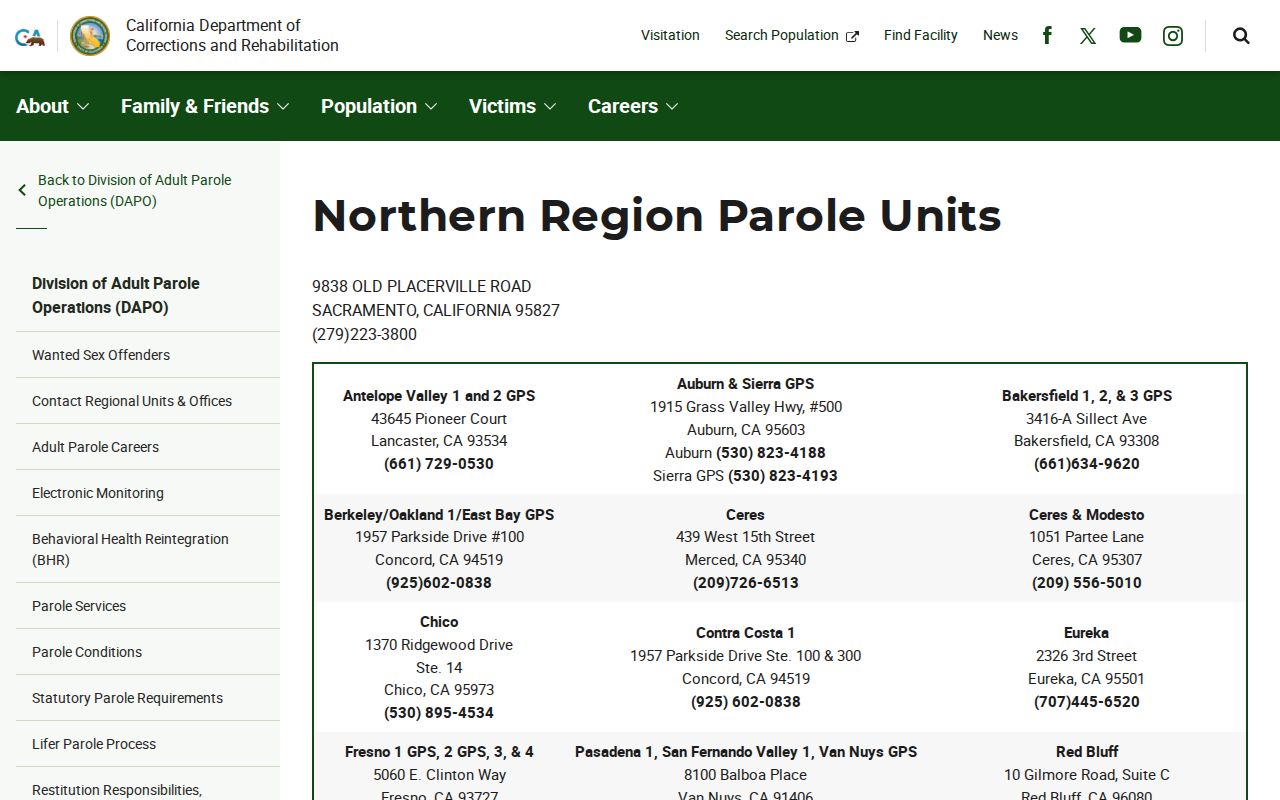
That state directory should be used for parole office contact details rather than an old jail booking page or a third-party listing.
STOPP After Shasta County Release
The Shasta County Community Corrections Center creates a local post-release checkpoint that does not exist in every county. Probation says STOPP, Successful Transitions on Probation and Parole, is a monthly event run with CDCR Parole for people on formal probation, PRCS, mandatory supervision, and parole. Supervised people released from custody are required to attend within 30 days of release.
STOPP is not a jail search. It is a reentry and supervision event where people meet providers and sign up for at least one treatment program or service. For release verification, it helps explain why a person may move from custody records into probation, parole, and service-provider contact. It also shows why the Shasta Community Corrections Center belongs in a post-release workflow, while the current-custody roster does not answer supervision questions.
STOPP also helps separate release from discharge. A person attending because of formal probation, PRCS, mandatory supervision, or parole has already left a custody setting, but that person has not necessarily finished all legal obligations. The event points to supervision and services after release, not to a cleared record or closed case. For records work, the court order and supervising agency still define the obligation.
Shasta County Violations and Warrants
Conditions are the rules attached to a supervision term. They can come from a sentencing court, CDCR parole conditions, PRCS terms, or probation orders. Public records may show a violation petition, warrant, revocation matter, new court hearing, or BPH action, but they usually will not expose private case-management notes. Use public court entries and official agency contacts for status, not informal copies of older jail pages.
CDCR keeps separate paths for parole-related public safety issues, including wanted sex offender information through DAPO. California Megan's Law is also a registry for specified registrants, not a general released-inmate list. A person absent from a registry or wanted list has not been proven off supervision. The better question is whether the court, CDCR, or Shasta County Probation has a current public event tied to that release.
A violation can also change the custody path. A probation violation may return the person to local court and local jail. A parole violation may involve DAPO and CDCR processes. A PRCS violation may involve county supervision and court action. The public record should be read by event, not by label alone, because the same word "violation" can point to different agencies.
Shasta Parole Hearing Records
Some Shasta County convictions become state-prison cases where the Board of Parole Hearings matters. BPH is part of CDCR and handles parole-suitability proceedings for eligible categories, including life-with-possibility cases and other parole-review groups. That is not the path for an ordinary jail bond release or a short local sentence. It applies when the person is in CDCR custody and a parole-suitability or eligibility process is involved.
The BPH hearing schedule lists hearings and says schedules are updated weekly on Thursday morning. BPH material also explains that hearings can be held by videoconference unless the Board determines in-person communication is needed. A scheduled hearing is not a release confirmation. It is a proceeding that may grant, deny, postpone, continue, or otherwise resolve a parole question.
For a Shasta reader, the practical sequence is simple: use CIRIS for the CDCR record, BPH for hearing status and outcomes, and DAPO or county probation for the supervision path after release. County jail staff are not the source for a later CDCR parole-suitability decision.
Shasta County Supervision Discharge
Supervision ends through discharge, court order, expiration of term, revocation outcome, or another agency action. For probation and mandatory supervision, the Shasta Superior Court record is often the durable public source. For PRCS, CDCR explains that the person is discharged from CDCR jurisdiction when released to county PRCS, so county records become central after the CDCR release. For state parole, DAPO and CDCR records are the better path.
Release and discharge are not the same event in every case. A person can leave jail and still have probation, parole, PRCS, a court date, or a warrant matter. A person can also complete supervision while old booking records, court records, or public registry records remain in separate systems. Keep the lookup tied to the source that made the current decision.
If the question is whether supervision has ended, look for a discharge entry, termination order, probation completion entry, PRCS status change, or parole discharge information. A jail no-match does not answer that question. It only shows that the person is not currently visible in that jail channel.