
VINE Coverage in Shasta County
The Shasta County Sheriff's Office has a local VINE page and links users to California VINELink. VINE is a custody-status and notification system. It can help with a current jail custody event, a release notification, or a transfer alert for a participating record. It should not be described as a complete historical list of Shasta County released inmates.
For a local jail matter, VINE works alongside the Shasta in-custody path, the court case, and any release record requested from the Sheriff's Office or county records process. For a state-prison matter, California's state correctional path may involve CDCR CIRIS, parole eligibility records, and parole or PRCS supervision. Federal custody is outside VINE's Shasta jail coverage and should be checked through BOP or federal court channels.
That split is the main reason VINE should be used for a specific person rather than as a general release list. A family member, victim, attorney, or other concerned person can search the named person and register for a custody-change alert. Someone trying to reconstruct an older release should use the release record, court case, and CDCR or federal records if those systems apply.
The California VINELink state page is the broad entry point. The California VINELink person search is the more direct path for a one-person lookup.
Shasta County's VINE page shows the local registration context for release notifications.
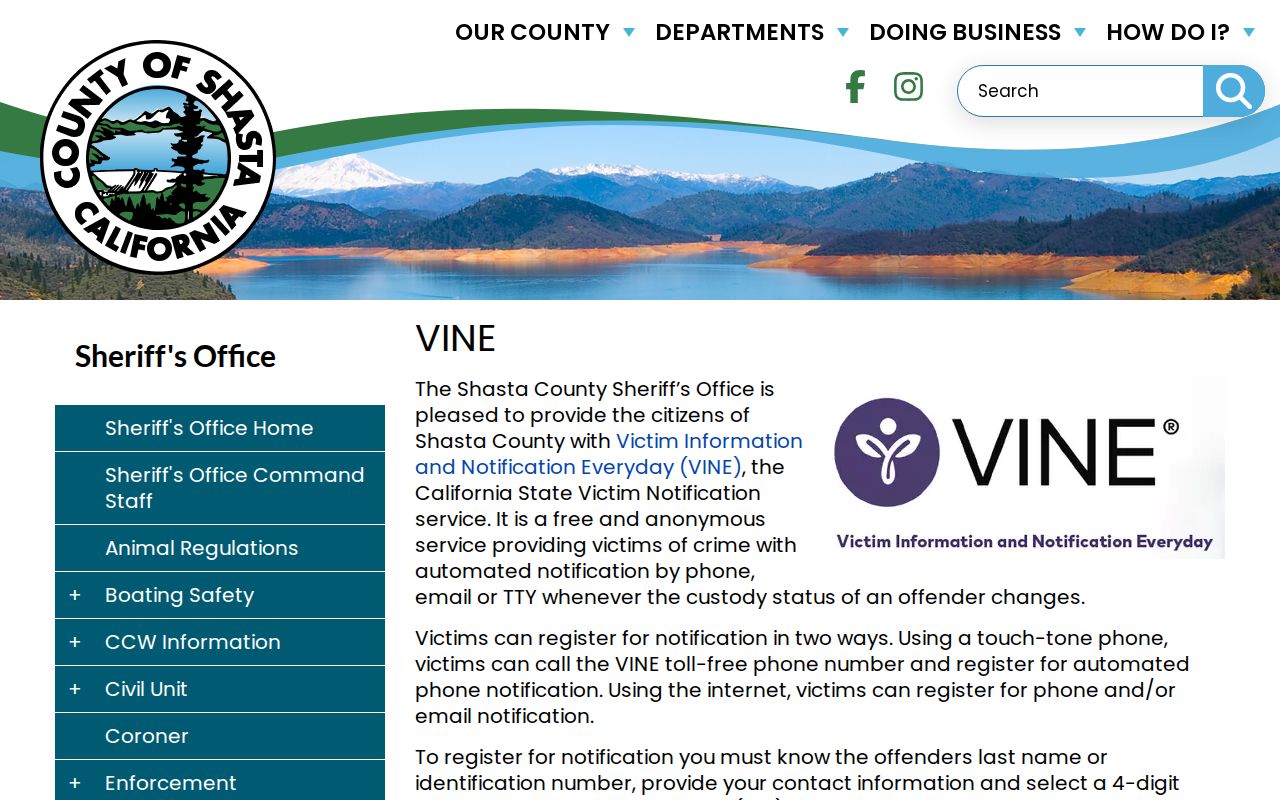
The local page is important because it gives Shasta-specific update and PIN information that a generic state search page may not explain in the same way.
Search a Shasta Inmate on VINE
A VINE inmate check is a name or ID search for one person. It is not the same as browsing a full release list. Use the most exact name, spelling, and identifier available. If the person has a common name, compare age, facility, middle initial, custody location, and any case details before registering for alerts.
The Shasta page says a user must know the offender's last name or identification number to register. The ID can be useful when names are common or spelled in more than one way. If the person was booked under an alias, married name, hyphenated name, or partial name, compare the VINE result with the court case or current-custody record before treating it as the right person.
- Open the California person search at VINELink.
- Search by last name or identification number when the number is known.
- Use first name, middle initial, date of birth, or facility clues to separate similar results.
- Open the matching record and review custody status and facility, if displayed.
- If no result appears, check spelling, aliases, the Shasta County current-custody lookup, and CDCR CIRIS if a state-prison term may apply.
- Confirm a release through the Shasta court case, Sheriff's release record, or CDCR record when the VINE result is not enough.
The broader Shasta County released-inmate search path is useful when VINE does not find a person or when a custody change needs official records support.
Reading a Shasta VINE Release
A released result or release alert should be read as a custody-status event. It may tell the registered user that the person was released or had a custody change after Shasta's booking system updated the VINE database. It does not always explain the legal reason. The reason may be bail, own recognizance release, time served, dismissal, transfer, sentence completion, court order, or another agency hold.
When the release reason matters, compare VINE with Shasta Superior Court and the Sheriff's release record. The court can show bail, sentence, dismissal, probation, bench warrant, or prison commitment. The release record can identify time and manner of release or a receiving agency. VINE is strongest as the notice layer, not the final record layer.
A transfer alert needs extra care. A person may leave Shasta County Jail because county custody ended, but the release event may point to CDCR, another county, federal custody, medical transport, or another agency. In that situation, VINE can tell the user that custody status changed, while the release record and receiving agency explain where the person went next.
If the person later appears in CIRIS, BOP, or another custody system, the Shasta VINE event should be read as the local transition point. It does not erase the need to follow the new agency.
Shasta VINE Release Fields
VINE may show custody status, facility, and person identifiers when a record is active in a participating feed. Shasta's local page confirms that custody-status changes generate automated notifications to the registered phone or email. The exact wording of a displayed release result can vary by record and interface, so avoid treating a screen label as a certified release document.
Because VINE is event-based, the absence of a person can mean several things. The person may be released, transferred, outside the participating feed, entered under another name, or no longer available in the public VINE search. Use the result as a clue, then move to the source agency record when the answer must be precise.
| Field or event | What it can show |
|---|---|
| Name or ID searched | The person matched in the California VINELink person search. |
| Custody status | Whether VINE has a participating custody record or custody-change event. |
| Facility | The jail, prison, or custody location shown by the participating feed, when available. |
| Release or transfer alert | A notification that custody status changed after the source system updated VINE. |
| PIN | The four-digit code used to confirm receipt and stop repeated phone calls. |
Important: VINE can notify you of a Shasta County release or custody change, but the court record and agency release record remain the stronger confirmation sources.
Shasta VINE Fifteen-Minute Updates
Shasta's local VINE page gives a useful local timing detail: information is updated in near real time from the local booking system to VINE databases about every 15 minutes. That is stronger than a generic statement that VINE is updated "regularly." It also has a limit. Fifteen minutes is not instant, and it does not guarantee that every release event will display permanently in a public search.
The same Shasta page explains the PIN process. A registrant selects a four-digit PIN. When a phone notification arrives, entering the PIN confirms receipt and stops repeat calls. If the PIN is not entered, calls continue until the PIN is entered or for 48 hours from the first notification. That makes the PIN more than a password. It is the receipt signal for automated calls.
The 15-minute timing should not be applied to every Shasta County web page. The research found that cadence on the VINE page, not on a separate official 24-hour or 72-hour release feed. If the current-custody lookup and VINE seem out of step, wait for the source systems to update and verify with the release record when the answer affects a court or family decision.
California VINELink provides the state entry point for Shasta County custody alerts.
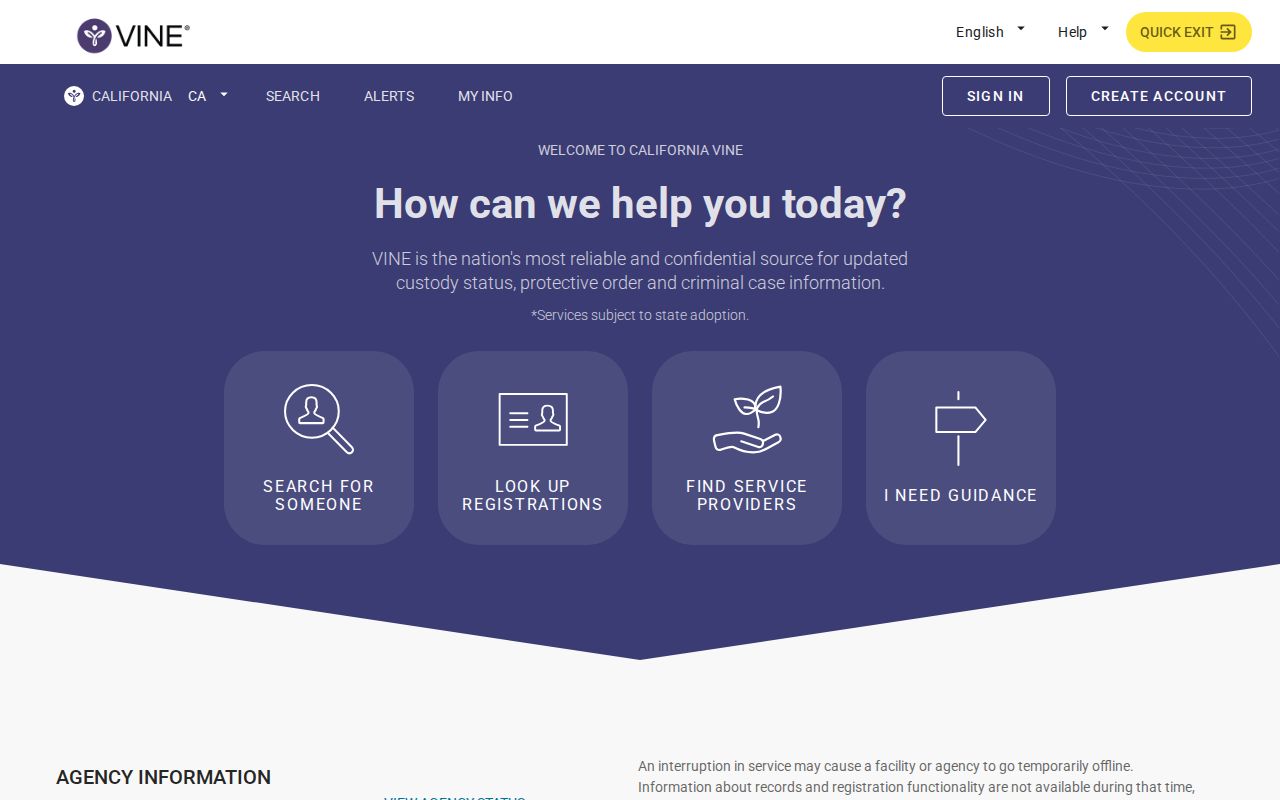
The state page supports the local Shasta workflow when the user needs to search or register through the statewide VINELink interface.
Register for Shasta Release Alerts
Registration starts after the right person is selected. The local Shasta page says a user needs the offender's last name or identification number, contact information, and a four-digit PIN. Phone help is available through California VINE at 1-877-411-5588, and TTY access is listed as 1-866-847-1298.
Shasta's VINE instructions also say the service is available every day with live operator assistance in English and Spanish. That makes the phone path important when web access is difficult, when the interface is not clear, or when the user needs help registering for an automated alert. The phone path still uses the same basic facts: last name or ID, contact method, and PIN.
- Search for the person in California VINELink.
- Open the matching result only after checking identifiers.
- Choose the notification registration option shown by the interface.
- Enter a phone number or email address when those options are offered.
- Select a four-digit PIN and keep it available.
- Confirm registration through the prompts.
- Enter the PIN when a phone alert arrives to confirm receipt.
Note: VINE alerts should supplement a broader safety or release-notification plan and should not be the only source used for legal or court timing.
VINE Limits for Shasta Releases
VINE does not replace the Shasta County release record. A released person can leave the current jail lookup, trigger a VINE alert, and still require court or records-office confirmation. A person can also be transferred to CDCR, another county, federal custody, or another agency. In those cases, the Shasta jail release event is only one part of the custody trail.
Federal custody is separate. BOP, federal court, and U.S. Marshals channels apply to federal inmates and federal pretrial custody. CDCR CIRIS applies when a Shasta County conviction became a state-prison commitment. VINE is most useful for the participating jail or state custody notice, then the matching agency record should be checked.
VINE can also miss the question a user is really asking. If the question is "what did the court order," use Shasta Superior Court. If the question is "what time and manner of release did the jail record show," use the Sheriff's release record or a PRA request. If the question is "where is a released state prisoner supervised," use CDCR, DAPO, or Shasta County Probation depending on parole or PRCS.
For Shasta County, the best use of VINE is timely notice. The best record of what happened is still held by the agency that made or recorded the custody decision. Keeping those roles separate prevents a release alert from being mistaken for a court judgment, sentence calculation, or supervision discharge.